


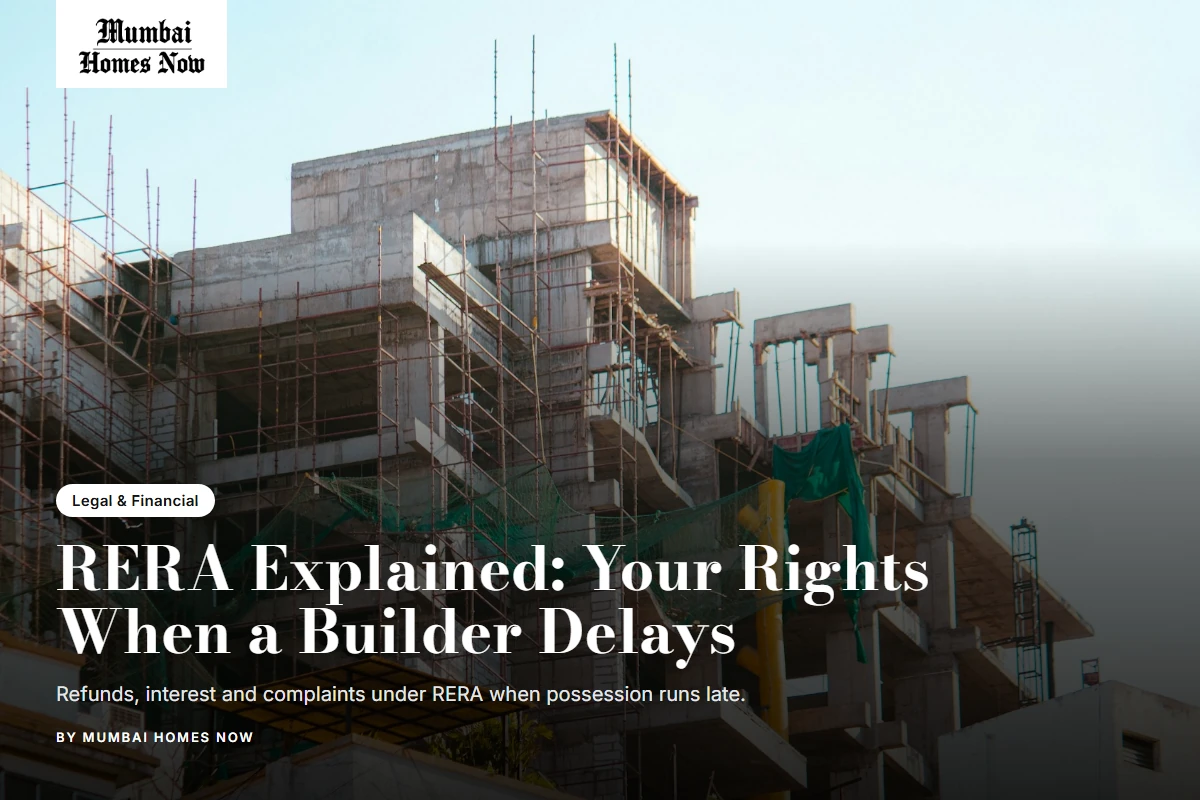
A delayed flat means paying EMIs on a loan while also paying rent. The Real Estate (Regulation and Development) Act, 2016 (RERA) gives buyers a legal route to remedies. This guide explains what the law provides, how to enforce it, and what to do in Maharashtra.
This is general legal awareness, not legal advice. Outcomes depend on your agreement, the project’s facts and your state’s rules, so consult a property lawyer for your case.
1. What Is RERA and Why Was It Introduced?
The Real Estate (Regulation and Development) Act, 2016 was introduced to regulate the real estate sector, improve transparency and protect the interests of property buyers.
2. How Does RERA Protect Homebuyers Against Builder Delays?
The most important protection for buyers facing delayed possession is provided under Section 18 of the RERA Act.
Section 18 – Right to refund or interest for delayed possession
If a promoter fails to complete a project or hand over possession according to the agreement for sale by the specified date, or is unable to provide possession due to the circumstances covered by the provision, the allottee may have two broad remedies.
Option 1: Withdraw from the project
If the buyer decides not to continue, Section 18(1) provides for a refund of the amount received by the promoter, together with prescribed interest and compensation in accordance with the Act.
Option 2: Continue with the project
If the buyer does not wish to withdraw, the promoter is liable to pay interest for every month of delay until possession is handed over, at the prescribed rate.
The distinction is important: the buyer’s choice to withdraw or continue affects the remedy available under Section 18. Compensation is also subject to the relevant statutory provisions and adjudication process; it should not be assumed that every delay automatically results in an additional compensation award.
Read the official text of Section 18 of the RERA Act.
It establishes a framework for registering qualifying projects, disclosing project information and addressing complaints against promoters and real estate agents.
Under the Act, state and union territory authorities oversee implementation within their respective jurisdictions. The law also provides for Real Estate Appellate Tribunals to hear appeals against regulatory decisions.
Some of its important features include:
- Registration of qualifying real estate projects and real estate agents.
- Public disclosure of project details, approvals and construction progress.
- Defined responsibilities for developers.
- Protection of buyers’ rights under the agreement for sale.
- A regulatory mechanism for addressing complaints and disputes.
RERA registration is not required for every project. Section 3 provides exemptions, including projects where the land area does not exceed 500 square metres or the number of apartments does not exceed eight, inclusive of all phases, subject to applicable state provisions. Certain completed and specified renovation or redevelopment projects are also exempt. Refer to Section 3 of the RERA Act.
Section 19: Rights of Allottees
Buyers have the right to:
- Information about sanctioned plans and project specifications
- Stage-wise construction schedules
- Possession as per the agreement and the law
- Refund and interest where the Act’s conditions are met
- Necessary documents and plans after possession
These rights help buyers monitor the project and understand whether the developer is meeting the agreed commitments. See Section 19 of the RERA Act.
What Is the Builder’s Responsibility Under RERA?
Section 11: Duties of the Promoter
The promoter must maintain project information and disclosures, follow the Act and the agreement, share relevant information with buyers and complete the project as committed.
Section 14: Adherence to Sanctioned Plans
The promoter must build according to sanctioned plans and specifications, and changes are allowed only as the Act provides.
Section 13 – Advance payment and agreement for sale
A promoter cannot accept more than 10% of the cost of an apartment, plot or building as an advance payment or application fee without first entering into a written agreement for sale with the buyer and registering it as required by law.
The agreement should specify important details, including the construction particulars, payment schedule, possession date and applicable interest provisions.
Read Sections 13 and 14 of the RERA Act.
4. Can a Builder Extend the Project Completion Date Under RERA?
Yes, but a developer cannot freely extend a project registration date simply by informing buyers that possession will be delayed.
Section 6 of RERA allows the regulatory authority to extend project registration in specified circumstances. These include force majeure events such as floods, earthquakes, cyclones and other natural calamities affecting project development.
The authority may also grant an extension in reasonable circumstances, without default on the promoter’s part, based on the facts of the individual case and reasons recorded in writing. Under the statutory proviso, such an extension cannot exceed an aggregate period of one year.
For buyers, it is important to distinguish between:
- The original completion date declared in the RERA registration.
- An extension formally approved by the regulatory authority.
- The possession date and other commitments in the agreement for sale.
An approved extension of project registration should not automatically be treated as a complete answer to every buyer’s contractual or statutory claim. Review the official project record and seek advice on how the extension affects your particular circumstances.
Refer to Section 6 of the RERA Act.
5. How to Check Whether a Project Is RERA Registered
Before purchasing an under-construction property, verify its registration with the relevant state or union territory RERA authority.
Steps to verify a project
- Visit the official RERA website for the state where the property is located.
- Search using the project name, registration number or promoter details.
- Check the registered project details and declared completion date.
- Review sanctioned plans, approvals and other disclosed documents.
- Check the latest construction progress and project updates.
- Review any extension orders, complaints or regulatory actions available on the portal.
Do not rely only on a developer’s general brand information. Verify the specific project and phase in which you intend to purchase a property. Under RERA, phases are generally treated as separate projects for registration purposes.
Maharashtra example
For properties in Mumbai, Thane, Navi Mumbai, Pune and other Maharashtra locations, buyers can use the official MahaRERA website.
The portal provides access to registered project information, project updates, extensions, non-compliant project lists and available regulatory orders.
How Can Homebuyers File a RERA Complaint Against a Builder?
Step by Step
- Gather your Agreement for Sale and payment receipts.
- Download the project’s RERA registration details.
- Record the promised possession date and the delay.
- Collect correspondence, notices and project updates.
- Identify your state RERA’s complaint process.
- File the complaint with supporting documents and the applicable fee.
- Follow the authority’s directions and attend hearings.
For more information, read Section 31 of the RERA Act.
Maharashtra example: Filing a MahaRERA complaint
MahaRERA provides an online complaint process for grievances involving registered projects. Its published procedure explains the online application, supporting documents, filing requirements and hearing process.
Visit the MahaRERA complaint filing guidance and check the current complaint instructions before submitting an application.
What Documents Should Buyers Keep When a Builder Delays Possession?
- Registered Agreement for Sale
- All booking and payment receipts
- Project RERA registration details
- The original possession commitment
- Extension orders, if any
- Emails, letters and messages with the developer
- Construction progress records and photographs
- Any notices or earlier complaint orders
Note – Keep the original documents safely and maintain digital copies. Written communication is particularly useful when seeking clarification about revised possession dates or requesting action from the promoter.
8. Maharashtra-Specific RERA Protection for Homebuyers
Homebuyers in Mumbai, Thane, Navi Mumbai and other Maharashtra locations can approach the Maharashtra Real Estate Regulatory Authority (MahaRERA) for applicable grievances involving registered projects.
Some important points to check include:
- Whether the specific project or phase is registered.
- The declared project completion and possession details.
- Quarterly construction updates and disclosed approvals.
- Any registration extension or regulatory order.
- The available complaint and conciliation procedures.
What interest rate applies to delayed possession in Maharashtra?
Under Rule 18 of the Maharashtra Real Estate (Regulation and Development) Rules, 2017, the prescribed interest rate payable by the promoter or allottee is the State Bank of India’s highest Marginal Cost of Lending Rate (MCLR) plus 2 percentage points. If MCLR is no longer in use, the rule provides for replacement by the applicable benchmark lending rate fixed by SBI.
This is a Maharashtra-specific rule and should not be presented as the rate applicable throughout India. Other states and union territories may prescribe different rates.
Read Rule 18 of the Maharashtra RERA Rules and check the current applicable benchmark before calculating a claim.
9. Common Mistakes Homebuyers Should Avoid When Dealing with Builder Delays
| Common mistake | Recommended action |
| Relying only on verbal possession commitments | Refer to the registered Agreement for Sale. |
| Ignoring the original possession date | Record the contractual date and applicable conditions. |
| Not checking project registration | Verify the specific project and phase on the RERA portal. |
| Accepting revised timelines without checking approvals | Verify whether a formal registration extension was granted. |
| Failing to retain payment records | Keep receipts and bank statements. |
| Assuming every delay guarantees a full refund | Understand the withdrawal and continuation remedies under Section 18. |
| Waiting too long to understand legal remedies | Review the applicable provisions and seek timely legal advice. |
A buyer should assess the agreement, project record and circumstances of the delay before deciding whether to continue with the project or pursue a refund.
10. Frequently Asked Questions About RERA and Builder Delays
1. What happens if a builder delays possession under RERA?
Under Section 18, a buyer may seek a refund with prescribed interest and compensation if they withdraw from the project under the applicable conditions. A buyer who continues with the project may claim interest for every month of delay until possession is handed over.
2. Can I get a full refund if the builder fails to deliver my flat on time?
Section 18 provides a refund remedy where the specified circumstances are met and the buyer chooses to withdraw. The refund includes the amount paid, prescribed interest and compensation in accordance with the Act.
3. Can I claim interest if I do not want to cancel my booking?
Yes. Section 18(1) provides for interest for every month of delay until possession is handed over if the allottee does not intend to withdraw.
4. How much interest can a builder be required to pay?
The prescribed rate depends on the applicable state or union territory rules. In Maharashtra, Rule 18 refers to SBI’s highest MCLR plus 2 percentage points, subject to the rule’s benchmark replacement provision.
5. Can a builder legally extend the possession date under RERA?
A project registration extension may be granted by the authority under Section 6 in specified circumstances. A builder cannot assume that simply notifying buyers automatically changes the approved project timeline or removes other legal obligations.
6. How can I file a RERA complaint against a builder?
Under Section 31, an aggrieved person can file a complaint with the relevant Regulatory Authority or adjudicating officer, as applicable. Follow the online filing procedure and documentation requirements of the relevant state authority.
7. Does RERA apply to all residential projects?
No. Section 3 provides exemptions based on project size, apartment count, completion status and specified renovation or redevelopment circumstances. State-specific rules must also be considered.
8. Can I approach MahaRERA for delayed possession in Mumbai or Thane?
Yes. Buyers can approach MahaRERA for applicable grievances concerning registered projects in Maharashtra by following its prescribed complaint procedure.
Conclusion
RERA provides important safeguards for homebuyers by requiring project disclosures, defining promoter responsibilities and establishing remedies for specified violations and delayed possession.
For a buyer facing a construction delay, Section 18 is particularly important because it provides a choice between withdrawing from the project and seeking a refund, or continuing with the purchase and claiming interest for the delay, subject to the applicable statutory conditions.
Before taking action, review the registered Agreement for Sale, verify the project’s RERA status, check any approved extension and organise all payment and communication records. Maharashtra homebuyers can also use MahaRERA’s project records and complaint process to understand the available regulatory remedies.
Understanding these rights can help buyers make informed decisions rather than relying solely on revised possession assurances from a developer.
Disclaimer: This article is for general legal awareness and educational purposes, not legal advice. The availability of refund, interest or compensation depends on the facts, agreement, applicable state rules and regulatory or judicial decisions. Consult a qualified property lawyer before initiating legal proceedings.