

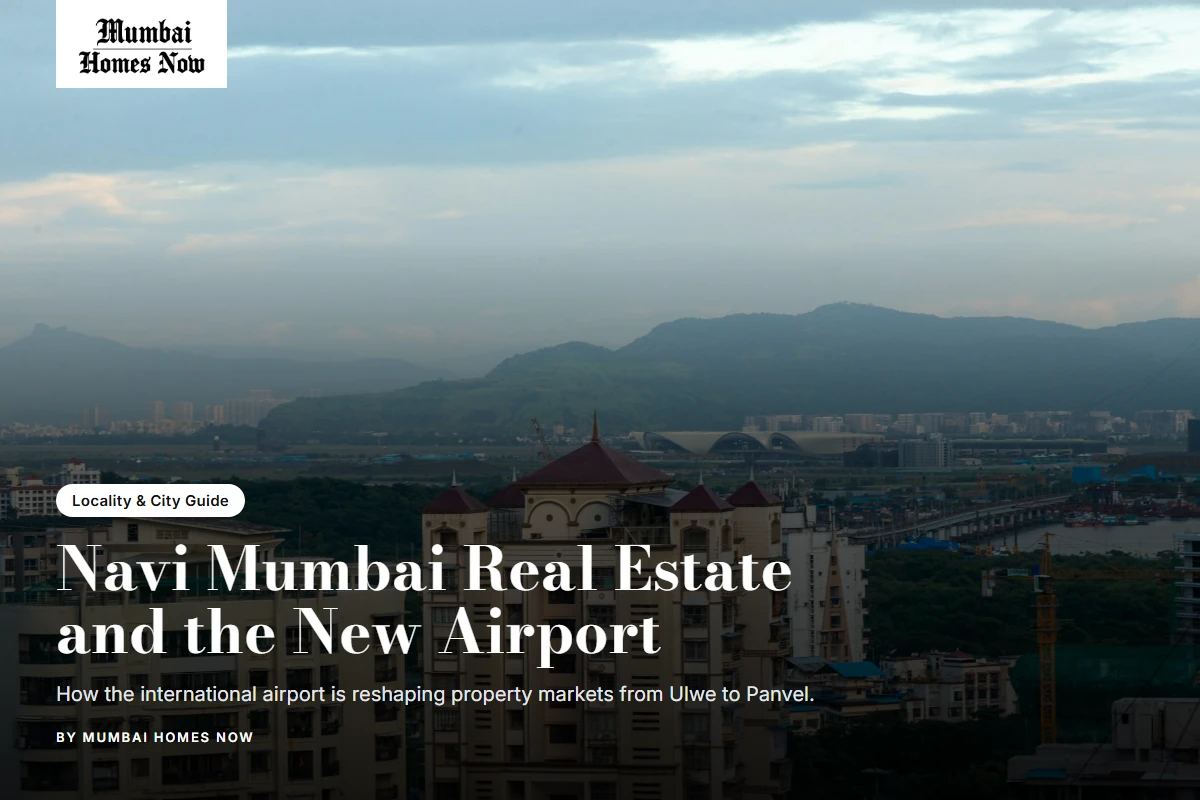
Navi Mumbai’s real estate market is entering a new phase with the opening of the Navi Mumbai International Airport (NMIA). The airport adds a second major aviation gateway to the Mumbai Metropolitan Region (MMR), potentially improving regional connectivity and creating opportunities across residential, commercial and logistics markets.
However, the airport is only one part of a much larger infrastructure story. Road links, metro connectivity, employment generation, planned development and local civic infrastructure will all influence how the property market evolves.
For homebuyers and investors, the important question is not simply whether an area is close to the airport. It is whether that location offers practical connectivity, sustainable demand, suitable housing supply and long-term liveability.
This guide examines the airport’s current status, emerging property corridors, infrastructure projects, market trends and risks to consider before investing in Navi Mumbai.
1. Navi Mumbai International Airport – What Has Changed?
Navi Mumbai International Airport began domestic commercial operations on 25 December 2025, adding another aviation gateway to the Mumbai Metropolitan Region. The airport was inaugurated in October 2025 and is being developed in phases, with passenger-handling capacity expected to expand as traffic grows.
The first phase is designed to handle substantial domestic passenger traffic, while subsequent development phases are planned to increase capacity. The airport is intended to complement Chhatrapati Shivaji Maharaj International Airport (CSMIA), supporting a dual-airport system for the region.
International operations began on 15 July 2026 with Air India Express services to Abu Dhabi, according to Business Standard’s report on the launch.
Airline operations are also expected to expand. In October 2026, Air India Group announced selected domestic operations from December 2026 and a phased transition of some international services. IndiGo separately announced plans to begin international operations from February 2027. These are announced plans, not confirmation that all services have started. See the Air India announcement and IndiGo’s announcement.
2. How Can the New Airport Influence Navi Mumbai’s Real Estate Market?
An international airport can influence real estate through several economic and infrastructure-related factors.
Improved regional connectivity: Better access to domestic and international destinations can make nearby employment and residential locations more convenient for businesses, travellers and employees.
Employment generation: Airport operations can support jobs in aviation, cargo handling, logistics, hospitality, retail, maintenance and other services. These activities may generate additional demand for housing and commercial spaces.
Commercial property demand: Business parks, hotels, offices, warehousing and logistics facilities may benefit as airport-related business activity develops.
Residential demand: Employees, professionals and businesses associated with the airport ecosystem may seek housing in accessible parts of Navi Mumbai.
However, the airport alone cannot determine property demand. Employment growth, actual transport links, housing supply, affordability and the quality of local infrastructure will influence how much economic activity translates into residential and commercial demand.
The JLL August 2026 analysis of the Navi Mumbai airport corridor identifies airport activity, connectivity and government infrastructure investment as important factors shaping the region’s property outlook.
3. Which Navi Mumbai Locations Could Benefit from the Airport?
Different locations have different advantages. Buyers should compare actual travel routes, existing infrastructure and property prices rather than relying only on distance from the airport.
1. Ulwe
Ulwe is among the locations most directly associated with the airport-led development corridor. Its position near NMIA and its road and rail connections have attracted residential development and buyer interest.
The area may appeal to buyers seeking access to the airport and the wider Navi Mumbai region. However, the exact travel time depends on the sector, route and availability of completed connecting roads.
Check the quality of local roads, water supply, drainage, social infrastructure and the specific project’s approvals before purchasing.
2. Panvel
Panvel has an established residential base and access to rail and road networks. Its location also connects it to the wider Mumbai–Pune region and airport-related infrastructure.
It may attract households seeking established services alongside access to future employment and logistics activity. Buyers should compare neighbourhood-level connectivity and the distance from the actual airport access point.
3. Kharghar
Kharghar has an established residential environment with educational institutions, healthcare facilities, retail options and planned public spaces.
Its appeal is not based solely on airport proximity. Existing social infrastructure and connectivity to other Navi Mumbai nodes make it relevant for families and working professionals.
The airport may strengthen its regional accessibility, although the actual benefit depends on transport connections and travel requirements.
4. Taloja
Taloja offers comparatively accessible housing options in parts of the locality and has an industrial and employment base.
Its longer-term residential appeal will depend on improvements in public transport, road connectivity and civic infrastructure. Buyers should examine the exact sector and surrounding development rather than assuming that all parts of Taloja benefit equally from airport access.
5. New Panvel and Dronagiri
New Panvel and Dronagiri form part of the wider airport-influenced corridor. Their potential is linked to regional connectivity, logistics, industrial activity and planned development.
These locations may suit buyers with longer investment horizons, but infrastructure execution, local demand and resale liquidity need careful evaluation.
JLL’s August 2026 analysis identifies Ulwe, Panvel and Kharghar as more established transaction markets, while describing Taloja, Karanjade, New Panvel and Dronagiri as emerging locations. This is a market assessment, not a guarantee of future appreciation.
4. Infrastructure Projects That Could Strengthen Airport Connectivity
The airport’s long-term real estate influence will depend partly on the transport infrastructure connecting it to residential and commercial centres.
Atal Setu and road connectivity
The Mumbai Trans Harbour Link, commonly known as Atal Setu, provides a major road connection between Sewri in Mumbai and the Nhava Sheva side of Navi Mumbai. It has been operational since January 2024 and has improved road access between Mumbai and parts of Navi Mumbai.
It is an important part of the wider airport connectivity network, although the actual journey to NMIA depends on the connecting roads used.
Ulwe Coastal Road and airport access roads
The Ulwe Coastal Road is planned to provide a more direct connection between Atal Setu and NMIA. It is intended to reduce dependence on the existing route through Chirle Junction and Amra Marg.
As of November 2026, recent reports continued to describe the road as under development, with a revised completion target around November. Buyers should check the latest CIDCO updates before treating the road as fully operational.
Proposed Metro Line 8
Metro Line 8 is proposed to connect Chhatrapati Shivaji Maharaj International Airport with Navi Mumbai International Airport.
The Maharashtra government has approved the project, but it should not be described as operational. A November 2026 report stated that CIDCO had appointed a consultant to obtain environmental and statutory clearances, with construction targeted for March 2027 subject to approvals. Refer to the latest reported Metro Line 8 status.
NAINA development
The Navi Mumbai Airport Influence Notified Area (NAINA) is a planned development area around the airport. CIDCO has been appointed as its Special Planning Authority.
Its development plan includes residential, mixed-use, industrial, warehousing and other designated areas. The long-term potential depends on planning implementation, infrastructure delivery, approvals and the pace of actual development.
Buyers can review the official CIDCO NAINA information and relevant development-plan notifications before considering land or property in the notified area.
5. What Is Happening to Property Prices in Navi Mumbai?
Airport-related expectations have become an important part of Navi Mumbai’s real estate narrative. However, price movement differs across localities and property categories.
In its August 2026 analysis, JLL reported that average residential prices in Navi Mumbai had increased by approximately 27% over five years. It also noted sharper growth in airport-proximate locations such as Ulwe and Panvel.
This figure should be read as JLL’s market assessment for its stated period and coverage, not as a uniform increase across every Navi Mumbai locality or property type.
Several factors influence local property prices:
- Distance from NMIA and access to completed roads.
- Availability of rail, metro and public transport.
- Existing schools, hospitals, retail and civic infrastructure.
- New residential supply and competition between projects.
- Employment opportunities and rental demand.
- Property age, construction quality and developer credentials.
It is also important to distinguish between advertised asking prices and actual registered transaction values. Property portals generally display listing-based prices, which may differ from negotiated sale prices. Buyers can compare listings with available registration information through the Maharashtra Inspector General of Registration portal.
For a more meaningful comparison, examine the same property type and carpet-area basis over a consistent period rather than relying on broad locality averages.
6. Residential vs Commercial Real Estate Opportunities
The airport may influence different property segments in different ways.
| Property segment | Potential airport-related demand |
| Residential apartments | Housing demand from employees and professionals |
| Rental housing | Potential demand from aviation and business-related workers |
| Office spaces | Aviation support, services and business activity |
| Warehousing and logistics | Cargo handling and supply-chain activity |
| Hotels and hospitality | Business travellers and airport-related stays |
| Retail and commercial spaces | Increased local consumption and service requirements |
Residential demand depends on employment growth and household affordability. Commercial demand depends on business activity, leasing requirements and the development of supporting infrastructure.
Warehousing and logistics may benefit from cargo-related activity, while hotels and retail businesses may respond to passenger movement and business travel.
Each segment has different investment costs, vacancy risks, operating requirements and holding periods. Investors should evaluate them separately rather than assuming that airport growth will benefit every property category equally.
7. Is Navi Mumbai a Good Real Estate Investment After the Airport Opens?
Navi Mumbai offers several factors that may support long-term real estate demand, including the new airport, Atal Setu, established residential nodes and planned infrastructure development.
Potential advantages include:
- Improved regional access through the airport and road network.
- Potential employment and business activity.
- Multiple residential and commercial growth corridors.
- Infrastructure-led development opportunities.
- A mix of established and emerging residential locations.
However, buyers and investors should also consider the risks:
- Some property prices may already reflect future infrastructure expectations.
- Supporting roads and metro projects may face delays.
- Certain micro-markets may experience excess housing supply.
- Rental demand and resale liquidity can vary considerably.
- Local civic infrastructure may not keep pace with construction.
- Airport proximity does not necessarily mean a short or convenient commute.
A property should be evaluated on its location, total acquisition cost, project approvals, developer credentials, rental demand and likely exit options. Buying solely because a project is marketed as airport-adjacent can lead to unrealistic expectations.
8. What Should Homebuyers Check Before Buying in Navi Mumbai?
Before finalising a property, review the following:
- Check the actual road distance and travel time to NMIA from the specific project.
- Verify current road and public transport connectivity.
- Review water supply, drainage, waste management and civic infrastructure.
- Compare asking prices with available registered transaction values.
- Check the project’s MahaRERA registration and disclosures, where applicable.
- Verify land title, sanctioned plans and development approvals.
- Evaluate nearby employment centres and rental demand.
- Assess the total purchase cost, maintenance charges and long-term affordability.
A location that works for airport access should also meet your everyday requirements, including commuting, schools, healthcare and access to essential services.
9. Frequently Asked Questions About Navi Mumbai Airport and Real Estate
1. How will Navi Mumbai International Airport affect property prices?
The airport may support demand through improved connectivity, employment and commercial activity. However, property prices will also depend on supply, local infrastructure, affordability and actual buyer demand.
2. Which areas are closest to Navi Mumbai International Airport?
Ulwe is among the residential areas closest to the airport. Actual travel distance and time depend on the sector, road access and available routes.
3. Is Ulwe a good location for property investment?
Ulwe has potential because of its proximity to NMIA and developing infrastructure. Buyers should still assess project approvals, local amenities, prices and connectivity before investing.
4. Will Panvel benefit from the new airport?
Panvel may benefit from airport-related employment, logistics and improved regional connectivity. Its established residential base is another factor supporting its market relevance.
5. What is Metro Line 8?
Metro Line 8 is a proposed corridor intended to connect Mumbai’s existing international airport with NMIA. It is not operational, and its construction depends on the completion of approvals and implementation processes.
6. Will the airport increase rental demand in Navi Mumbai?
It may create additional rental demand if airport-related employment and business activity grow. The actual impact will vary by locality, property type and connectivity.
7. Is it better to buy residential or commercial property near NMIA?
The choice depends on investment capital, income requirements, holding period, vacancy risk and management capacity. Residential and commercial properties have different demand drivers and costs.
8. Is Navi Mumbai a good long-term real estate investment?
It has several infrastructure and development drivers, but future returns are not guaranteed. Evaluate the specific locality, property fundamentals, purchase price and exit liquidity before making a decision.
Conclusion
Navi Mumbai International Airport is an important addition to the Mumbai Metropolitan Region’s infrastructure. Alongside Atal Setu, planned road connections, Metro Line 8 and NAINA development, it may influence residential and commercial demand across a wider regional corridor.
Ulwe, Panvel and Kharghar already have established market activity, while Taloja, Karanjade, New Panvel and Dronagiri offer different development and investment considerations.
For homebuyers, the most sensible approach is to look beyond the airport announcement. Verify actual connectivity, assess local infrastructure, compare market prices and examine the legal and financial fundamentals of the property.
The airport may create opportunities, but the quality of the location, project and purchase decision will ultimately matter more than proximity alone.
Disclaimer: This article is for general educational purposes and is not investment or financial advice. Infrastructure timelines, market conditions and property values may change. Verify project status, connectivity and transaction information with the relevant authorities before making a property decision.